CLASSIFICATION OF ELEMENTS & PERIODICITY IN PROPERTIES
1. INTRODUCTION
Periodic table may be defined as the table which classifies all the known elements in accordance with their properties in such a way that elements with similar properties are grouped together in the same vertical column and dissimilar elements are separated from one another.
2. HISTORICAL DEVELOPMENT OF THE PERIODIC TABLE
All earlier attempts of the classification of the elements were based upon their atomic weights.
2.1 Dobereiner’s Triads
In 1829, Dobereiner classified certain elements in the groups of three called triads. The three elements in a triad had similar chemical properties. When the elements in a triad were arranged in the order of increasing atomic weights, the atomic weight of the middle element was found to be approximately equal to the arithmetic mean of the other two elements.

2.2 Newland’s Law of Octaves
In 1865, an English chemist, John Alexander Newlands observed that when the lighter elements were arranged in order of their increasing atomic weights, the properties of every eighth element were similar to those of the first one like the eighth note of a musical scale. This generalisation was named as Newlands’s law of octaves.


2.3 Lothar Meyer’s Curve
“Physical properties of elements are periodic functions of their atomic masses.”
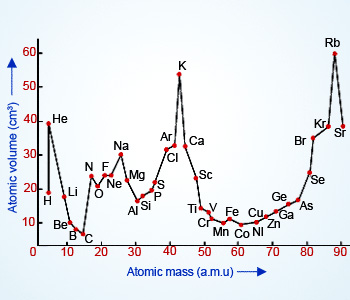
According to Lothar Meyer, elements having similar properties occupy the similar positions in atomic volume viz atomic mass curve.
2.4 Mendeleev’s Periodic Law & Table
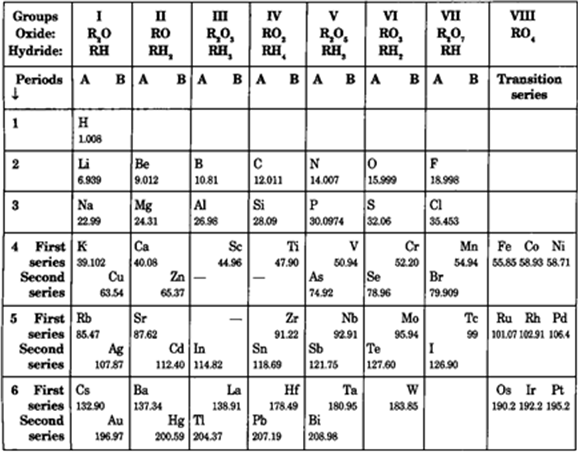
Mendeleev arranged elements in horizontal rows and vertical columns of a table in order of their increasing atomic weights in such a way that the elements with similar properties occupied the same vertical column or group.
"The physical and chemical properties of the elements are periodic functions of their atomic masses."
2.5 Modern Periodic Law & Table
In 1913, the English physicist, Henry Moseley observed regularities in the characteristic X-ray spectra of the elements. A plot of √v (where √v is frequency of X-rays emitted) against atomic number (Z) gave a straight line and not the plot of √v vs atomic mass. Mendeleev’s Periodic Law was, therefore, accordingly modified. This is known as theModern Periodic Law and can be stated as :
"The physical and chemical properties of the elements are periodic functions of their atomic numbers."


Nomenclature of elements with Atomic Numbers > 100
The naming of the new elements had been traditionally the privilege of the discoverer and the suggested name was ratified by the IUPAC.

3. PREDICTION OF BLOCK, PERIOD & GROUP

4. PROPERTIES OF AN ELEMENT
4.1 Atomic Radius
We cannot measure the exact size of an isolated atom because its outermost electron have a remote chance of being found quite far from the nucleus. So different types of atomic radius can be used based on the environment of atoms i.e; covalent radius, van der Waals’ radius,metallic radius.
4.1.1 Covalent Radius
The half of the distance between the nuclei of two identical atoms joined by single covalent bond in a molecule is known as covalent radius.


where χA and χB are electronegative of A and B
4.1.2 Van der Waal’s Radius
It is half of the internuclear distance between adjacent atoms of the two neighbouring molecules in the solid state.


4.1.3 Metallic Radius (Crystal radius)
It is one-half of the distance between the nuclei of two adjacent metal atoms in the metallic crystal lattice.


4.2 Variation of Atomic Radii in the Periodic Table
(a) Variation along a period
In general, the covalent and van der Waals radii decrease with increase in atomic number as we move from left to right in a period.
4.3 Atomic Radii
(a) Variation along a period
It is because with in the period the outer electrons are in the same valence shell & the effective nuclear charge increases as the atomic number increases resulting in the increased attraction of electrons to the nucleus.
(b) Variation along a group
Atomic radius in a group increase as the atomic number increases. It is because with in the group, the principal quantum number (n) increases and the valence electrons are farther from the nucleus.
(c) Ionic Radius
The removal of an electron from an atom results in the formation of a cation, whereas gain of an electron leads to an anion.
In general, the ionic radii of elements exhibit the same trend as the atomic radii. A cation is smaller than its parent atom because it has fewer electrons while its nuclear charge remains the same. The size of an anion will be larger than that of the parent atom because the addition of one or more electrons would result in increased repulsion among the electrons and a decrease in effective nuclear charge. For example, the ionic radius of fluoride ion (F–) is 136 pm whereas the atomic radius of fluorine is only 64 pm. On the other hand ,the atomic radius of sodium is 186 pm compared to the ionic radius of 95 pm for Na+.
(d) Isoelectronic Species
Isoelectronic species are those which have same number of electrons. For example, O2–, F–, Na+ and Mg2+ have the same number of electrons (10). Their radii would be different because of their different nuclear charges. The cation with the greater positive charge will have a smaller radius because of the greater attraction of the electrons to the nucleus. Anion with the greater negative charge will have the larger radius. In this case, the net repulsion of the electrons will outweigh the nuclear charge and the ion will expand in size. Order of atomic radii is

General Trend-

4.4 Ionization Energy
The minimum amount of energy required to remove the electron from the outermost orbit of an isolated atom in the gaseous state is known as ionization energy.

IE1, IE2, IE3 and IE4 are successive ionization energies.

Variation of Ionisation Energy in Periodic Table
(a) Variation along a period
In a period, the value of ionisation enthalpy increases from left to right with breaks where the atoms have somewhat stable configurations. The observed trends can be easily explained on the basis of increased nuclear charge and decrease in atomic radii. Both the factors increase the force of attraction towards nucleus and consequently, more and more energy is required to remove the electrons and hence, ionisation enthalpies increase.
(b) Variation along a group
On moving the group, the atomic size increases gradually due to an addition of one new principal energy shell at each succeeding element. On account of this, the force of attraction towards the valence electrons decreases and hence the ionisation enthalpy value decreases.
4.5 Units of I.E./I.P.
It is measured in units of electron volts (eV) per atom or kilo calories per mole (kcal mol–1) or kilo Joules per mole (kJ mol–1). One electron volt is the energy acquired by an electron while moving under a potential difference of one volt.

Important Points
* Ionization energy increases with decreasing the size of an atom or an ion
* Ionization energy increases with decreasing screening effect.
* Ionization energy increases with increasing nuclear charge
* Ionization energy increases if atom having half filled and fully filled orbitals
* The penetrating power of orbitals is in the order s > p > d > f

4.6 Electron Gain Enthalpy
When an electron is added to a neutral gaseous atom (X) to convert it into a negative ion, the enthalpy change accompanying the process is defined as the Electron Gain Enthalpy (DegH). Electron gain enthalpy provides a measure of the ease with which an atom adds an electron to form anion as represented by
X(g) + e– -> X–(g)
Depending on the element, the process of adding an electron to the atom can be either endothermic or exothermic. For many elements energy is released when an electron is added to the atom and the electron gain enthalpy is negative. For example, group 17 elements (the halogens) have very high negative electron gain enthalpies because they can attain stable noble gas electronic configurations by picking up an electron. On the other hand, noble gases have large positive electron gain enthalpies because the electron has to enter the next higher principal quantum level leading to a very unstable electronic configuration.
Variation of Electron Gain Enthalpy
(a) Variation along a period
Electron gain enthalpy becomes more and more negative from left to right in a period. This is due to decrease in size and increase in nuclear charge as the atomic number increases in a period. Both these factors favour the addition of an extra electron due to higher force of attraction by the nucleus for the incoming electron.
(b) Variation along a group
The electron gain enthalpies, in general, become less negative in going down from top to bottom in a group. This is due to increase in size on moving down a group. This factor is predominant in comparison to other factor, i.e., increase in nuclear charge.

4.7 Electronegativity
The tendency of an atom to attract the shared pair of electrons towards itself is known as its electronegativity. According to Pauling, the electronegativity of F is 4.0 and electronegativity of other elements can be calculated as


(where IP = Ionization potential, EA = Electron affinity)
If IP and EA are taken in electron volt
* Percentage ionic character = 16(χA – χB) +
3.5(χA – χB)2 where χA and χB are electronegativities of A and B.
* If the difference in the electronegatives of combining atoms is 1.7, the bond is 50% covalent and 50% ionic.
* If the difference in electronegativities of oxygen and element is very high the oxide shows a basic character.

The periodic trends of elements in the periodic table

4.8 Periodic Trends in Chemical Properties
4.8.1 Periodicity of Valence or Oxidation States
The electrons present in the outermost shell of an atom are called valence electrons and the number of these electrons determine the valence or the valency of the atom. It is because of this reason that the outermost shell is also called the valence shell of the atom and the orbitals present in the valence shell are called valence orbitals. In case of representative elements, the valence of an atom is generally equal to either the number of valence electrons (s- and p-block elements) or equal to eight minus the number
of valence electrons.


In contrast, transition and inner transition elements, exhibit variable valence due to involvement of not only the valence electrons but d- or f-electrons as well. However, their most common valence are 2 and 3.
Let us now discuss periodicity of valence along a period and within a group.
(a) Variation along a period
As we move across a period from left to right, the number of valence electrons increases from 1 to 8. But the valence of elements, w.r.t. H or O first increases from 1 to 4 and then decreases to zero. In the formation of Na2O molecule, oxygen being more electronegative accepts two electrons, one from each of the two sodium atoms and thus shows an oxidation state of –2. On the other hand, sodium with valence shell electronic configuration as 3s1 loses one electron to oxygen and is given an oxidation state of +1. Thus, the oxidation state of an element in a given compound may be defined as the charge acquired by its atom on the basis of electronegativity of the other atoms in the molecule.
(b) Variation within a group
When we move down the gorup, the number of valence electrons remains the same, therefore, all the elements in a group exhibit the same valence. For example, all the elements of group 1 (alkali metals) have valence one while all the elements of group 2 (alkaline earth metals) exhibit a valence
of two. Noble gases present in group 18 are zerovalent, i.e., their valence is zero since these elements are chemically inert.
4.8.2 Anomalous Properties of Second Period Elements
It has been observed that some elements of the second period show similarities with the elements of the third period placed diagonally to each other, though belonging to different groups. For example, lithium (of group 1) resembles magnesium (of group 2) and beryllium (of group 2) resembles aluminium (of group 13) and so as. This similarity in properties of elements placed diagonally to each other is called diagonal relationship.
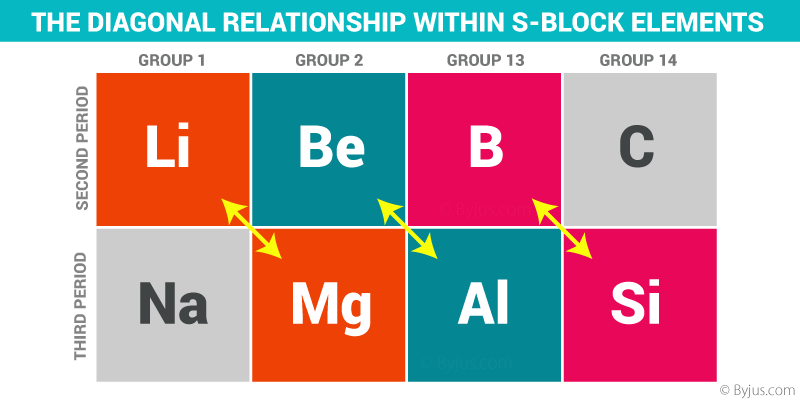
The anomalous behaviour is due to their small size, large charge/radius ratio and high electronegativity of the elements. In addition, the first member of group has only four valence orbitals (2s and 2p) available for bonding, whereas the second member of the groups have nine valence orbitals (3s, 3p, 3d). As a consequence of this, the maximum covalency of the first member of each group is 4 (e.g., boron
can only form [BF4]–), whereas the other members of the groups can expand their valence shell to accommodate more than four pairs of electrons e.g., aluminium forms [AlF6]3–. Furthermore, the first member of p-block elements displays greater ability to form pp-pp multiple bonds to itself (e.g., C
=C, CºC, N=N, NºN) and to other second period elements (e.g., C=O, C=N, NºC, N=O) compared to subsequent members of the same groups.
4.8.3 Periodic Trends and Chemical Reactivity
Reactivity of Metals
The reactivity of metals is measured in terms of their tendency to lose electrons from their outermost shell.
In a period
The tendency of an element to lose electrons decreases in going from left to right in a period. So, the reactivity of metals decreases in a period from left to right. For example, the reactivity of third period elements follows the order.

In a group
The tendency to lose electrons increases as we go down a group. So, the reactivity of metals increases down the group. Thus, in group 1, the reactivity follows the order.

Reactivity of Non-Metals
The reactivity of a non-metal is measured in terms of its tendency to gain electrons to form an anion.
In a period
The reactivity of non-metals increases from left to right in a period. During reaction, non-metals tend to form anions. For example, in the second period, the reactivity of non-metals increases in the order.

In a group
The reactivity of non-metals in a group decreases as we go down the group. This is because the tendency to accept electrons decreases down the group. The reactivity of halogens follows the order

The normal oxide formed by the element on extreme left is the most basic (e.g., Na2O) whereas that formed by the element on extreme right is the most acidic (e.g., Cl2O7). Oxides of elements in the centre are amphoteric (e.g., Al2O3, As2O3) or neutral (e.g., CO, NO, N2O). Amphoteric oxides behave as acidic with bases and as basic with acids, whereas neutral oxides have no acidic or basic properties.

4.8.4 Inert Pair Effect
In groups 13-16, as we move down the group, the tendency of s-electrons of the valence shell to participate in bond formation decreases. This means that lower oxidation state becomes more stable.
Reason: As we go down these groups, the increased nuclear charge outweighs the effect of the corresponding increase in atomic size. The s-electrons thus become more tightly held (more penetrating) and hence more reluctant to participate in bond formation. Hence, the lower oxidation state becomes more stable.
5. SUMMARY AND IMPORTANT POINTS TO REMEMBER
1. Mendeleev’s periodic table was based on atomic masses of the elements. When Mendeleev presented the periodic table, only 63 elements were known. He left 29 places in the table for unknown elements.
2. Modern Mendeleev periodic table is based on atomic numbers of the elements. The modern periodic law is : “The physical and chemical properties of the elements are periodic function of their atomic numbers”. The horizontal row in the periodic table is called a period and vertical column is called group. There are seven periods and nine groups in the modern Mendeleev periodic table.
3. The long or extended form of periodic table consists of seven periods and eighteen vertical columns (groups or families). The elements in a period have same number of energy shells, i.e., principal quantum number (n). These are numbered 1 to 7.

In a vertical column (group), the elements have similar valence shell electronic configuration and therefore exhibit similar chemical properties.
4. There are four blocks of elements: s-, p-, d- and f-block depending on the orbital which gets the last electron. The general electronic configuration of these blocks are :

s-block elements occupy IA(1) and IIA(2) groups, i.e., extreme left portion of the periodic table. p-block elementsoccupy IIIA(13), IVA(14), VA(15), VIA(16), VIIA(17) and VIIIA(18) groups, i.e., right portion of the periodic table. d-block elements occupy IIIB(3), IVB(4), VB(5), VIB(6), VIIB(7), VIIB(8, 9 and 10), IB(11) and IIB(12) groups, i.e., central portion of the periodic table. There are four d-block series, i.e., 3d series, 4d series, 5d series and 6d series, each consisting of ten elements, i.e., in all forty d-block elements are present in periodic table. f-block elements are accommodated in two horizontal rows below the main periodic table, each row consists of 14 elements, i.e., 28 f-block elements are present in periodic table. The elements in first row are termed 4f-elements or rare earth or lanthanides while the elements of second row are termed 5f-elements or actinides.
5. The elements are broadly divided into three types :
(i) Metals comprise more than 78% of the known elements. s-block, d-block and f-block elements are metals. The higher members of p-block are also metals.
(ii) Non-metals are less than twenty. (C, N, P, O, S, Se, H, F, Cl, Br, I, He, Ne, Ar, Kr, Xe and Rn are non-metals).
(iii) Elements which lie in the border line between metals and non-metals are called semimetals or metalloids. B, Si, Ge, As, Sb, Te, Po and At are regarded metalloids.
6. IUPAC given a new scheme for assigning a temporary name to the newly discovered elements. The name is derived directly from the atomic number of the elements. However, IUPAC has accepted the following names of the elements from atomci numbers 104 to 110.

7. The recurrence of similar properties of the elements after certain definite intervals when the elements are arranged in order of increasing atomic numbers in the periodic table is termed periodicity. The cause of periodicity is the repetition of similar electronic configuration of the atom in the valence shell after certain definite intervals. These definite intervals are 2, 8, 8, 18, 18 and 32. These are known as magic number. Periodicity is observed in a number of properties which are directly or indirectly linked with electronic configuration.
(i) Effective nuclear charge increases across each period.
(ii) Atomic radii generally decrease across the periods.
(iii) Atomic radii generally increase on moving from top to bottom in the groups.
(iv) Atomic radius is of three types :
(a) Covalent radius : It is half of the distance between the centres of the nuclei of two similar atoms joined by a single covalent bond. This is generally used for non-metals.
(b) Crystal or metallic radius : It is half of the internuclear distance between two nearest atoms in the metallic lattice. It is generally used for metals.
(c) van der Waals’ radius : It is half of the internuclear distance between the nearest atoms belonging to two adjacent molecules in solid state.

(v) Cations are generally smaller than anions.
(vi) Cations are smaller and anions are larger than neutral atoms of the elements.

(vii) Elements of 2nd and 3rd transition series belonging to same vertical columns are similar in size and properties due to lanthanide contraction.
(viii) The first element is each group of the representative elements shows abnormal properties, i.e., differs from other elements of the group because of much smaller size of the atom.
(ix) The ions having same number of electrons but different nuclear charge are called isoelectronic ions.
Examples,
(a) N3–, O2–,
F–, Na+, Mg2+, Al3+
(b) P3–,
S2–, Cl–, K+, Ca2+, Sc3+
In isoelectronic ions, the size decreases if Z/e increases i.e., greater the nuclear charge, smaller is the size of the ion.
(x) The energy required to remove the most loosely held electron from the gaseous isolated atom is termed ionisation enthalpy.
(xi) Ionisation enthalpy values generally increase across the periods.
(xii) Ionisation enthalpy values generally decrease down the group.
(xiii) Removal of electron from filled and half filled shells requires of higher energy. For example, the ionisation enthalpy of nitrogen is higher than oxygen. Be, Mg and noble gases have high values.
(xiv) Metals have low ionisation enthalpy values while non-metals have high ionisation enthalpy values.
(xv) Successive ionisation enthalpies of an atom have higher values. IEI
< IEII < IEIII ...
(xvi) The enthalpy change taking place when an electron is added to an isolated gaseous atom of the element is called electron gain enthalpy. The first electron gain enthalpy of most of the elements is negative as energy is released in the process but the values are positive or near zero in case of the atoms having stable configuration such as Be, Mg, N, noble gases, etc.
(xvii) Electron gain enthalpy becomes more negative from left to right in a period and less negative from top to bottom in a group.
(xviii)Successive electron gain enthalpies are always positive.
(xix) The elements with higher ionisation enthalpy have higher negative electron gain enthalpy.
(xx) Electronegativity is the tendency of an atom to attract the shared pair of electrons towards itself in a bond.
(xxi) Electronegativity increases across the periods and decreases down the groups.
(xxii) Metals have low electronegativities and non-metals have high electronegativities.
(xxiii)Metallic character decreases across the periods and increases down the group.
(xxiv)Valence of an element belonging to s- and p- block (except noble gases) is either equal to the number of valence electrons or eight minus number of valence electrons.
(xxv) The reducing nature of the elements decreases across the period while oxidising nature increases.
(xxvi)The basic character of the oxides decreases while the acidic character increases in moving from left to right in a period.
6. SOME IMPORTANT FACTS ABOUT ELEMENTS
(i) Bromine is a non-metal which is liquid at room temperature.
(ii) Mercury is the only metal that is liquid at room temperature.
(iii) Gallium (m.pt. 29.8ºC), caesium (m.pt. 28.5ºC) and francium (m.pt. 27ºC) are metals having low melting points.
(iv) Tungsten (W) has the highest melting point (3380ºC) among metals.
(v) Carbon has the highest melting point (4100ºC) among nonmetals.
(vi) Oxygen is the most abundant element on the earth.
(vii) Aluminium is the most abundant metal.
(viii) Iron is the most abundant transition metal.
(ix) Highest density is shown by osmium (22.57 g cm–3) or iridium (22.61 g cm–3).
(x) Lithium is the lightest metal. Its density is 0.54 g cm–3.
(xi) Silver is the best conductor of electricity.
(xii) Diamond (carbon) is the hardest natural substance.
(xiii) Francium has the highest atomic volume.
(xiv) Boron has the lowest atomic volume.
(xv) The most abundant gas in atmosphere is nitrogen.
(xvi) Fluorine is the most electronegative element.
(xvii) Chlorine has the maximum negative electron gain enthalpy.
(xviii)Helium has the maximum ionisation enthalpy.
(xix) Cesium or francium has the lowest ionisation enthalpy.
(xx) Helium and francium are smallest and largest atoms respectively.
(xxi) H– and I– ions are the smallest and largest anions respectively.
(xxii) H+ and Cs+ ions are the smallest and largest cations respectively.
(xxiii) Cesium is the most electropositive element.
(xxiv) Element kept in water is phosphorus, P4 (white or yellow).
(xxv) Element kept in kerosene are Na, K, Rb, Cs, etc.
(xxvi) Iodine is the element which sublimes.
(xxvii) Hydrogen is the most abundant element in the universe.
(xxviii) Only ozone is the coloured gas with garlic smell.
(xxix) Metalloids have electronegativity values closer to 2.0.
(xxx) First synthetic (i.e., man-made) element is technetium (At. No. 43).
(xxxi) Most poisonous metal-Plutonium.
(xxxii)Rarest element in earth’s crust-Astatine.
(xxxiii) The elements coming after uranium are called transuranic elements. The elements with Z = 104 – 112, 114 and 116 are called trans-actinides or super heavy elements. All these elements are synthetic, i.e., man-made elements. These are radioactive elements and not found in nature.
(xxxiv) The elements ruthenium (Ru), germanium (Ge), polonium (Po) and americium (Am) were named in honour of the countries named Ruthenia (Russia), Germany, Poland and America, respectively.
(xxxv) The members of the actinide series are radioactive and majority of them are not found in nature.
(xxxvi) The element rutherfordium (Rf, 104) is also called Kurchatovium (Ku) and element dubnium (Db, 105), is also called hahnium.
(xxxvii) Promethium (Pm, 61) a member of lanthanide series is not found in nature. It is a synthetic element.
(xxxviii) Special names are given to the members of these groups in periodic table.

---X---
If you find these notes really helpful and easy to understand. Do like, comment and share. Keep following Gone Nuclear for more notes on CBSE IX, X, XI & XII. Follow us on Facebook on Gone Nuclear
Atish J. Bain
HOD (Dept. of Chemistry)
St. Thomas High School (10+2)
Dhanbad, Jharkhand